
 Layla Zulfa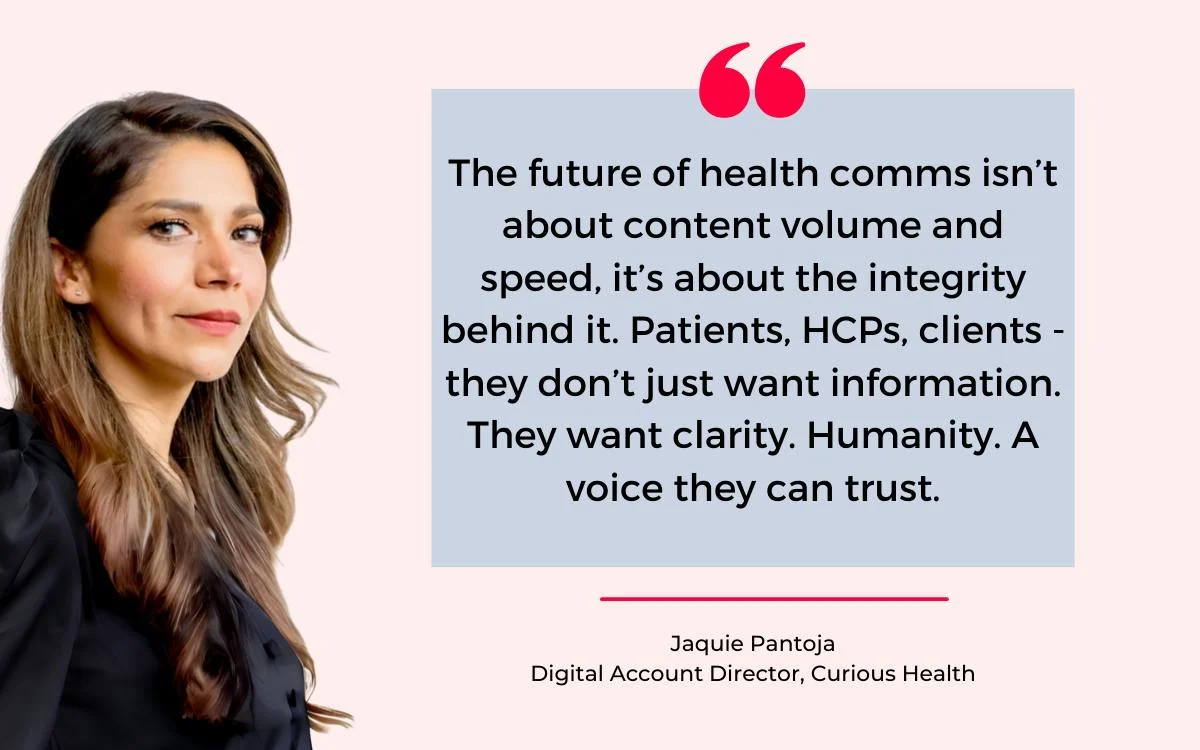
As we step into 2026, the pharmaceutical and healthcare sectors find themselves at a critical crossroads. The convergence of generative AI, a shifting regulatory landscape, and an increasingly skeptical public has dismantled the traditional playbooks that served the industry for decades. For marketing and communication leaders, the mandate for the year ahead is clear: move beyond the vanity metrics of the past and anchor strategy in human credibility, ethical AI integration, and measurable, patient-centric outcomes.
Jaquie Pantoja, Digital Account Director at Curious Health, argues that the industry is no longer battling isolated challenges, but a complex, overlapping web of pressures. From the erosion of traditional organic traffic to the delicate task of maintaining public trust in an era of rampant misinformation, the hurdles are significant—yet they offer a unique opportunity to redefine what it means to be a trusted health brand.
The Core Challenges: A Landscape in Flux
The healthcare marketing environment of 2026 is defined by three primary vectors of change: the transformation of discovery journeys, the fragility of public trust, and intense economic scrutiny.
1. The Rise of the "Zero-Click" Era
The most immediate challenge is the decline of traditional search. Generative AI tools—ChatGPT, Google’s AI Overviews, Perplexity, and Copilot—have graduated from experimental tech to the primary engines of high-intent discovery.
Data from 2025 indicates that AI platforms generated a staggering 1.13 billion referral visits globally in June alone—a 357% year-on-year increase. With ChatGPT accounting for nearly 80% of those referrals, the traditional "blue link" model of search engine optimization (SEO) is effectively being eclipsed by a "zero-click" reality. Brands that fail to optimize for AI-generated answers risk becoming invisible at the exact moment a patient or clinician is making a high-stakes decision.
2. The Trust Deficit
Public confidence in pharmaceutical institutions remains, at best, fragile. Lingering skepticism following the pandemic, ongoing debates over drug pricing, and a climate saturated with misinformation create a volatile backdrop for any health communication. Patients are increasingly sophisticated; they are no longer passive recipients of information but active researchers who demand transparency, scientific rigor, and empathy.
3. The Economic Imperative
Pricing and reimbursement have become the defining political and operational issues of the mid-2020s. In the UK, the Voluntary Scheme on Branded Medicines (VPAG) has placed significant pressure on industry budgets, leading to a cautionary pause in nearly £2 billion of investment. As healthcare systems globally face the dual pressures of an aging population and fiscal constraints, the pharma industry must reconcile the need for scientific innovation with the reality of patient affordability. As the industry often notes, "access delayed is access denied."
Chronology: From Static Content to Agentic Discovery
To understand the shift in healthcare marketing, one must look at the rapid evolution of the patient journey:
- 2023-2024 (The Experimental Phase): Brands began experimenting with LLMs for content generation, focusing on volume and efficiency.
- 2025 (The Integration Phase): AI search tools became the primary interface for health discovery. Referral traffic from AI platforms surged by 357%, signaling the end of the traditional search era.
- 2026 (The Credibility Phase): The current year marks a pivot. As AI content becomes commoditized and generic, the industry is shifting its focus toward "human-verified" content and high-authority thought leadership to rebuild trust.
Supporting Data: Why Human Connection Prevails
While technology dictates how patients discover information, it does not dictate how they validate it. Research into patient behavior reveals a stark disconnect between the convenience of AI and the necessity of human trust:
- Trust in Expertise: In the UK, 63% of patients report definite confidence and trust in their HCPs. This underscores that while a patient might start a search with an AI bot, the final decision is almost always validated by a human expert.
- The "Human-First" Demand: As AI-generated content floods the web, the premium on human-authored, peer-reviewed, and community-led content has skyrocketed.
- The Referral Shift: With the 357% increase in AI-driven traffic, the focus for marketers has shifted from "pageviews" to "influence." If an AI assistant provides an answer, the brand must ensure that its evidence is the primary source of that answer.
Official Perspective: Jaquie Pantoja on Strategic Shifts
In conversation with Econsultancy, Jaquie Pantoja emphasizes that the industry’s greatest bottleneck is not a lack of data, but an over-reliance on it at the expense of strategy.
"Marketing leaders now need to actively build AI search optimization strategies that work for both human and agentic AI audiences," Pantoja notes. She warns against viewing AI as a "holy grail." Instead, she advocates for a balanced approach: "AI is powerful, but it’s not a replacement for expertise, judgment, or human context. In healthcare especially, expert input still matters, and probably always will."
Regarding the future of PR and communications, Pantoja points to a paradigm shift: "LLMs cannot replicate relationship-building or emotional judgment. As more patient journeys begin inside AI assistants, PR shifts from simple awareness-building to a core driver of AI-era visibility and trust."
Implications for 2026: The "Human-Created" Premium
As we navigate the remainder of 2026, the implications for pharmaceutical and healthcare organizations are profound. To maintain competitive advantage, brands must adopt three strategic pillars:
1. Redefining Measurement
Measurement must move beyond vanity metrics. The most successful teams are now blending quantitative data (reach, engagement, AI visibility) with qualitative insights (stakeholder feedback, KOL sentiment, and case studies). The goal is to move from "data-rich" to "insight-driven."
2. The Rise of the "Human-Created" Label
Pantoja predicts that "human-created" will become a premium differentiator. In an ocean of AI-perfect, faceless video content, brands that lean into the "imperfect"—real clinician stories, raw patient experiences, and unscripted professional dialogue—will stand out. These elements of humanity serve as a signal of authenticity that AI currently cannot replicate.
3. Prioritizing Integrity Over Speed
The temptation to use AI to automate the entirety of the content supply chain is high, but the reputational risks in healthcare are severe. The brands that win in 2026 will be those that use AI for efficiency while strictly gatekeeping the "integrity layer" of their communications. This means human-led strategy, rigorous fact-checking, and a brand voice that resonates with the specific, nuanced needs of the patient community.
Final Takeaway
For the healthcare sector, 2026 is the year of the "human pivot." The technology used to deliver information has changed, but the fundamental requirement—trust—remains anchored in human connection. As Pantoja concludes, "What builds trust is not the content volume; it’s the integrity behind it. Patients, HCPs, and clients don’t just want information. They want clarity, humanity, and a voice they can trust."
By focusing on genuine expert voices, transparent scientific communication, and a commitment to authentic storytelling, healthcare brands can successfully navigate the AI-driven landscape of 2026, turning the challenges of fragmentation and distrust into a foundation for deeper, more meaningful patient relationships.


 Nana
Nana
 Suro Senen
 Nana Wu
 Asro
Asro
 Jia Lissa
 Neng Nana
 Dwi Wanna
 Siti Muinah